
Key Takeaways
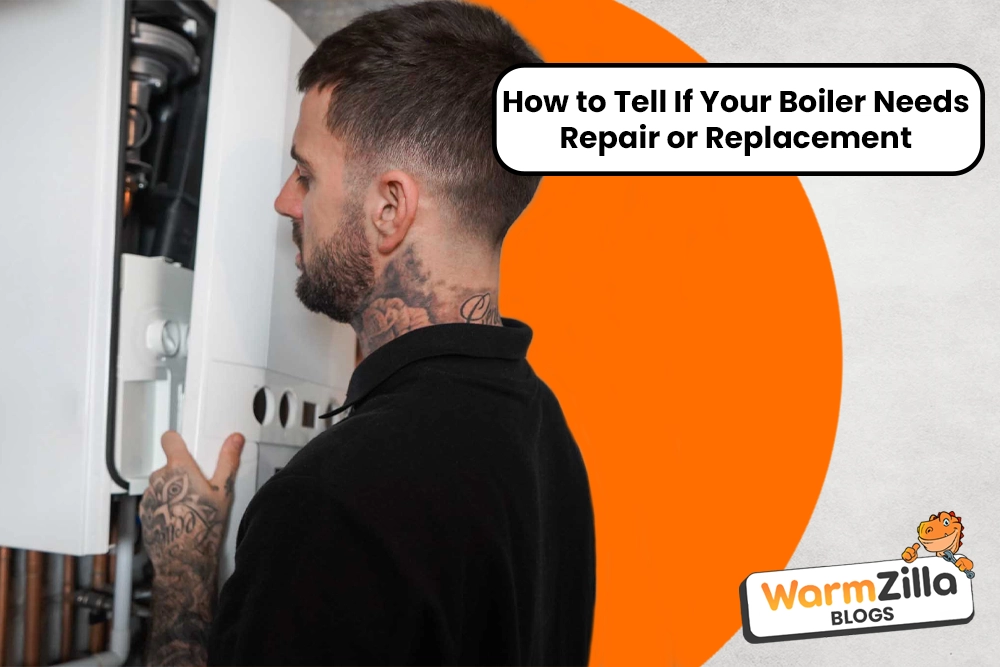
Your boiler is the heart of your home’s heating system. It has provided warmth and hot water for you and your loved ones for years.
However, like any appliance, boilers can develop issues over time.
When faced with a malfunctioning or inefficient boiler, homeowners have a crucial decision: should they repair their existing boiler or invest in a new one?
Before making your final choice, it is best to recognise the signs that your boiler needs attention.
Signs Your Boiler Needs Attention
Before deciding whether to repair or replace your boiler, it’s essential to recognise the signs that indicate trouble. Some common warning signs include the following:
Frequent Breakdowns
A major sign that your boiler needs to be replaced is that it needs frequent repairs, especially if the repairs become costly.
The top three most expensive repairs include:
- Heat exchanger replacement
- Gas valve replacement
- And replacing the printed circuit board replacement.
Most of these repairs cost between £300 and £1,500. You could buy a new boiler at the higher end of these quotes.
Uneven Heating
Uneven heating can be linked to many issues, such as:
- Air trapped radiators
- Sludge or limescale buildup
- Faulty thermostatic radiator valves
- Pump issues
- Poorly balanced heating system
- Blocked pipes
- Leaking pipes
- Poor insulation and drafts
- Or the boiler is incorrectly sized.
However, if certain rooms remain cold while others are warm, even after all of the above issues have been addressed, it is a clear sign that your boiler may be losing efficiency.
Strange Noises
Boilers usually make some noises. However, loud sounds like banging, whistling, or gurgling can indicate trapped air, limescale buildup, or mechanical issues.
Most strange noises can be addressed, but you should consider replacing your boiler if they become more regular.
Higher Energy Bills
Older boilers are inefficient. Non-condensing models lack technology that recycles exhaust fumes to reheat water.
In April 2018, the UK government introduced Boiler Plus, a set of new regulations to improve boiler efficiency and reduce carbon emissions. The law applies to all new boiler installations in England and enforces stricter efficiency standards.
However, the bottom line is that old boilers can significantly increase your energy costs.
Comparing efficiency ratings between old and new boilers:
| Boiler Type | Efficiency (%) | Energy Waste |
|---|---|---|
| Non-condensing (15+ years old) | 60–75% | 25–40% wasted |
| Early condensing boilers (10–15 years old) | 80–85% | 15–20% wasted |
| Modern condensing boilers (A-rated, new models) | 90–98% | Less than 10% wasted |
But the running cost differences between these boilers are where you can see the value of upgrading.
According to the Energy Savings Trust estimates based on replacing an old G-rated boiler with an A-rated model:
| Home Size | Annual Savings on Energy Bills |
|---|---|
| Small flat or house | £150–£200 |
| Medium-sized home | £200–£300 |
| Large home | £300–£500 |
If you receive high monthly energy bills, it might be time to upgrade.
Yellow Flame Instead of Blue
A significant safety concern is when your boiler’s pilot light starts burning as a yellow flame instead of a blue one.
Generally, a yellow pilot light flame strongly indicates incomplete combustion and will cause dangerous carbon monoxide build-up.
If your boiler’s pilot light is malfunctioning regularly, replace it for safety.
Leaks And Drips
Even the tiniest boil leak can be a massive problem and potentially cause property damage.
Signs that you have a leak problem include the following:
- Loss of boiler pressure
- Damp patches on walls, ceilings, or on floors
- Unusual sounds
- Rust or corrosion
- Cold radiator or uneven heating
- Increased water bills
- And if your home’s boiler is constantly running.
Now that we know the key signs that your boiler needs attention, when should you consider repairing it or looking to replace it?
When to Repair Your Boiler
Not every problem with your boiler means you should replace it.
Generally, there are these are the instances when you should repair your current boiler:


Boiler is Relatively New
The UK’s four top-selling boiler brands claim that their products’ lifespans range between 10-15 years.
These top-selling boiler brands are:
- Worcester Bosch
- Vaillant
- Ideal
- And Viessmann
If you’ve been able to maintain your boiler’s warranty and it’s relatively new, between 5-8 years, you should opt to repair it.
Minor Issues
Some boiler issues are minor.
These problems include:
- A faulty thermostat
- Pressure issues
- And small leaks
Ask a professional for their opinion on whether it is a simple and affordable repair.
Also, if your boiler has been well-maintained and serviced at the correct intervals, a repair might extend its lifespan without significant concerns.
However, there comes a time, or circumstances, when it is time to replace your boiler.
When to Replace Your Boiler
At some point, repairing an old boiler becomes impractical and a financial burden. Signs and situations when you need to replace your boiler include the following:


Age of the Boiler
As mentioned, most of the UK’s top boiler brands estimate their products’ lifespans to be 10–15 years.
If yours is older, it may not be worth repairing. If you are unsure of the age of your boiler, check its serial number.
Your boiler’s serial number can be found on:
- Boiler’s casing (usually
- In the user manual
- Or inside your boiler’s service book.
However, if you haven’t located the serial number, you can ask the manufacturer directly or a Gas Safe registered engineer.
Another issue with older boilers is that their parts become more challenging to replace and can become expensive.
The simple fact is that all manufacturers across all industries need to stop making replacement parts for older models.
Recurring Repairs
For those having to call in an expert to fix their boiler regularly, those repairs are starting to add up quickly.
Rather than continuously throwing money at an old boiler, it could be time to replace it.
Inefficiency
As mentioned, older boilers operate at lower efficiency levels, often below 70%, whereas modern condensing boilers boast efficiencies of 90% or more.
If your monthly energy bills are hurting your wallet, it might be time to replace your old boiler. For those who can’t seem to save enough to pay for a new boiler, you can finance it.
Safety Concerns
The safest option is to replace your boiler if it poses a risk due to leaks, carbon monoxide issues, or structural failures.
Now that we’ve highlighted reasons to consider placing your boiler let’s discuss costs.
Cost Considerations: Repair vs. Replacement
Cost is one of the most significant factors in deciding whether to repair or replace. Here’s a general cost comparison:
Boiler Repair Costs
Minor boiler repairs can cost between £100 and £500, whereas significant work costs £500 to £1,500.
Most boiler cover agreements have a Beyond Economical Repair (BER) clause or assessment.
The assessment will include the total cost of repairing your boiler (i.e., the price of the parts and labour) and compare it to its current value, considering depreciation of 10% per year.
If the total cost of repairing your boiler is 60% or more than the current manufacturer’s retail price, the boiler is deemed BER.
We’d strongly recommend crunching the numbers to work out if your boiler is BER.
To calculate if your boiler is considered to be BER, the formula is:
BER% = (Repair Cost / Replacement Cost) x 1000
If BER ≥ 50%, replacement is usually the better option. While a BER < 50% will mean repairing the boiler is the most cost-effective route, this also depends on factors like age and efficiency.
New Boiler Installation Costs
Replacing your home’s boiler with a new unit can vary depending on several factors.
Generally, the cost of replacing and installing a boiler is between £2,500 and £4,000 (supply and installation).
Long-Term Savings
While a new boiler requires an upfront investment, as mentioned, modern models significantly reduce energy bills, often paying for themselves over time through lower heating costs.
Now that we’ve reviewed all the factors involved in repairing or replacing your boiler, what is your final verdict on your situation?
Final Verdict: Repair or Replace?
Generally speaking, relatively new boilers that experience minor problems and have also been well-maintained should be repaired.
However, if your boiler is old, inefficient, or prone to frequent breakdowns, replacing it with a modern, energy-efficient model is the best long-term decision.
Which should you select if you’re now in the market for a new boiler?
WarmZilla Is Here To Help Selecting A New Boiler
Investing in the right boiler can save you money, improve home comfort, and ensure long-term safety. It’s a decision that can’t be made lightly.
Luckily, WarmZilla has developed an easy-to-complete survey to suggest the perfect boiler for your home.



Have a question? Please contact us on Live Chat
About the Author